





Buying wheel chocks for a Western Australian operation, whether a Perth transport yard or a remote mining site, is a procurement decision with a compliance dimension. This is a checklist for specifying and buying wheel chocks properly, so what arrives actually holds your vehicles on your ground.
Key points
- Chocking parked and loading heavy vehicles and trailers is a work health and safety control your procedures must cover.
- Specify the chock to your heaviest vehicle, your worst surface, and how it will be handled, not to a catalogue picture.
- For WA’s outdoor and remote conditions, polyurethane and moulded chocks outperform rubber on fuel, oil, heat and UV.
- Carewell supplies to WA nationally and will work to your required minimum order quantity.
The specification checklist
1. Rated load
Take your heaviest vehicle at its heaviest realistic load and specify a chock rated above it, with margin. A chock that holds an empty trailer will not hold a loaded one.
2. Tyre or wheel size and profile
The chock has to sit correctly against the tyre. Large mining and haulage tyres need a taller chock with a matching contact face; a standard truck chock will simply be pushed aside.
3. Surface and slope
Sealed hardstand suits a standard chock. Gravel, dirt, and any grade need a larger chock with an aggressive base profile, and often a spike or a bar connecting a pair so they cannot spread apart.
4. Material and environment
Polyurethane and moulded chocks resist fuel, oil, heat and UV far better than rubber, which matters for outdoor storage and remote WA sites. Rubber is fine for a sheltered workshop.
5. Handling and visibility
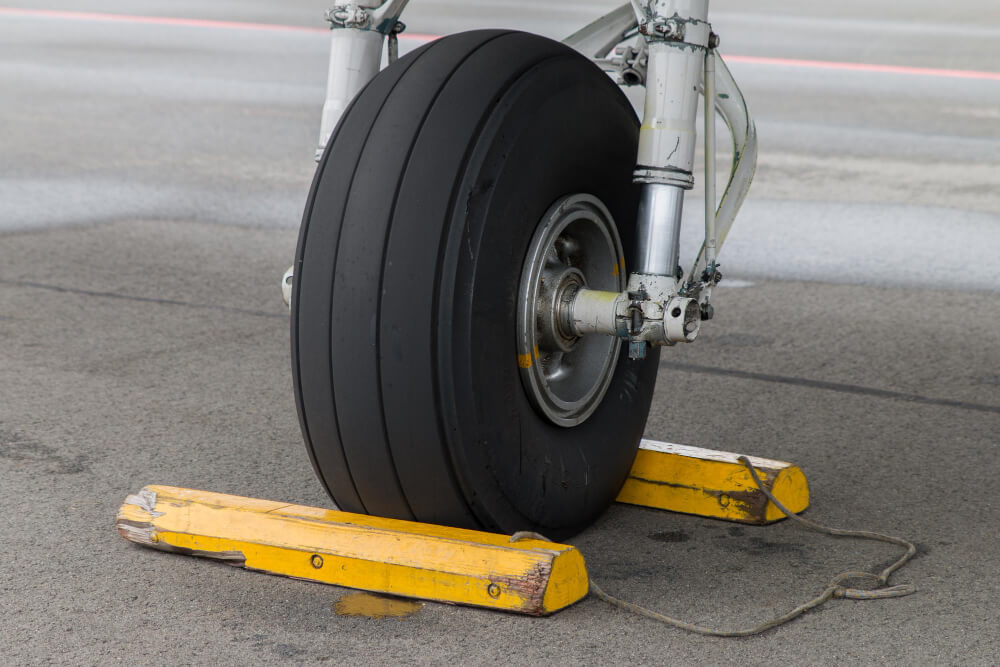
A long handle or a rope means an operator never reaches under a tyre to place or retrieve a chock. A high-visibility colour makes a placed chock obvious and a forgotten one findable. Add a “vehicle being loaded, do not move” sign at docks.
6. Quantity and placement
Work out chocks per vehicle from the vehicle type, the surface grade and whether the park brake is set. The wheel chock guide covers this. Then add spares for every site so a damaged or missing chock never stops an operation.
7. Replacement schedule
Chocks wear, crack and walk off. Build a periodic inspection and replacement cycle into your procedures rather than replacing only on failure.
Buying
Wheel chocks freight easily and do not degrade in storage, so a national supplier can serve a WA site well. Buy through an industrial safety or packaging supplier that carries the heavy-duty grades, handles, bars and signage, and that can spec against your fleet, rather than a general retailer with a limited light range.
Where Carewell fits
Carewell Group supplies wheel chocks to WA operations nationally, in rubber, polyurethane and moulded grades, with handles, signs and connecting bars, and builds vehicle-specific and branded chocks to a defined duty. Carewell can meet all your equipment and packaging needs in one place. Talk to our team about your fleet and sites and we will work to your required minimum order quantity. Request a quote and samples or call +61 (02) 8760 1491.
Frequently asked questions
How do I specify a wheel chock for a mining site?
Rate it above your heaviest vehicle, match the contact face to the tyre size, use an aggressive base profile and connecting bar for loose or sloped ground, choose polyurethane or moulded for the environment, and fit a long handle.
How many chocks do I need per vehicle?
It depends on the vehicle, the surface grade and the park brake. See the wheel chock guide.
Rubber or polyurethane for WA conditions?
Polyurethane or moulded for outdoor and remote use; rubber only for a sheltered workshop.
Should I hold spare chocks?
Yes, on every site, plus a periodic inspection and replacement cycle.
Can you build chocks to our specification?
Yes, vehicle-specific and branded chocks to a defined load and surface, to your minimum order quantity.
Written by Alif Vasaya, digital and content strategy, Carewell Group. Carewell Group is an Australian packaging, food packaging, tape, industrial safety and 3PL supplier serving Western Australia and all of Australia. Last updated 10 September 2026.